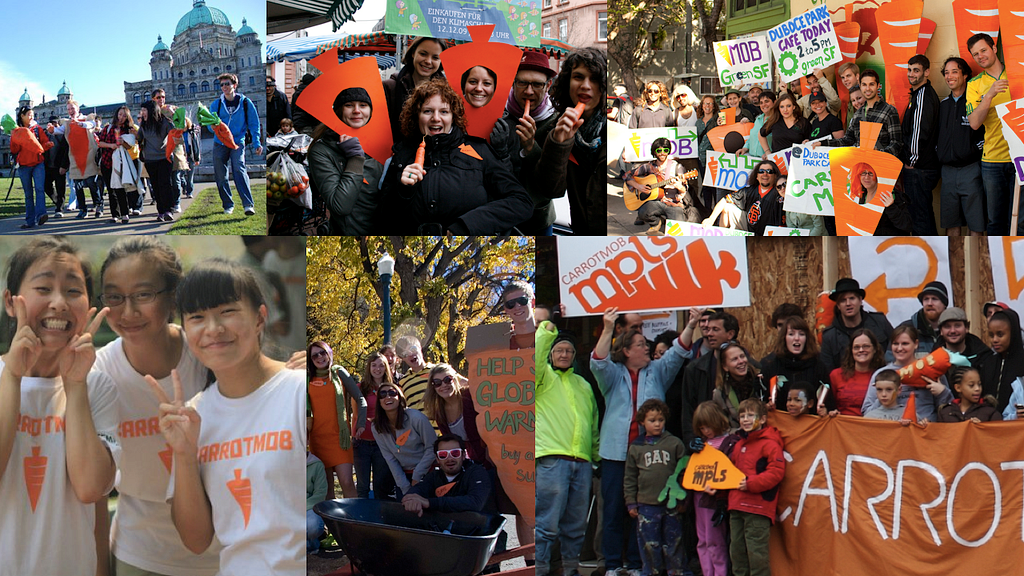
Ten years ago today I launched the Carrotmob movement by swarming a liquor store with hundreds of other people.
That day, it felt like my life was about to change forever. And then it did, as soon as this video came out and went viral:
When you spend ten years focused on the same problem, you learn a lot. I have incorporated most of what I learned into my new company MoneyVoice, but as we celebrate a decade of Carrotmob I also want to share some high-level insights that I think will be interesting for all who have been involved with Carrotmob over the years.
This post will summarize our successes, failures, insights, lessons learned, and how I gradually developed a new model that could more effectively advance the spirit of Carrotmob. It will explain how MoneyVoice is a natural evolution of Carrotmob, and why I believe that the impact of MoneyVoice will eventually fulfill all of Carrotmob’s ambitions, and more.
I’m so thankful for the tens of thousands of Carrotmob supporters who have encouraged me to keep walking down this path, and I hope you feel as excited to try MoneyVoice as I feel to finally share it with you.
Carrotmob Basics
For the uninitiated: A Carrotmob campaign is the opposite of a boycott: a group of people spends money to support a business, and in return the business makes an improvement that people care about. It’s a coordinated buying campaign in which customers create a positive incentive (a “carrot”) for businesses to do what people want.
There have been hundreds of campaigns in over 20 countries around the world. Our history, in brief: As this phenomenon spread around the world I started two companies and a non-profit in pursuit of the best way to support and scale the efforts of Carrotmob organizers and participants. Everyone loved being a Carrotmobber, and businesses always loved Carrotmob. Despite this, we never found a scalable, sustainable model, and we shut down.
Since then, I have continued volunteering to support Carrotmobbers. There continue to be Carrotmob campaigns around the world every few months, and I continue to get an email every week or two from someone asking about Carrotmob (this week it was from William in Texas… I’ll write back to you as soon as I can!).
Carrotmob Successes
Our campaigns made an impact by directly changing business practices at hundreds of businesses. Many of these changes were related to energy efficiency, waste reduction and other climate/environmental issues, and others were focused on social justice issues, such as selling healthy fruits and vegetables in poor neighborhoods without access, or giving restaurant workers paid sick leave.
Carrotmob has been very influential in the worlds of sustainability and activism. We were recognized as groundbreaking from the beginning…
“Carrotmobs Are Cooler than Boycotts” — Time Magazine
“Carrotmob is now aiming to use consumers’ buying power to shape global supply chains.” — Fast Company
“Civically-minded, tech savvy organization that understands the power of data.” — Forbes
“The Carrotmob philosophy has extended across America — and the world” — NY Times
…and I have also seen the scope of our influence behind the scenes. At least half a dozen companies have been started that were directly inspired by Carrotmob, many careers have been advanced by the experience of being a Carrotmob organizer, at least half a dozen students have written their master’s/doctoral thesis about Carrotmob, and I am constantly meeting people who attended a Carrotmob or have been touched by this movement in some way. It’s quite a legacy that all of you mobbers have built.
Carrotmob Failures
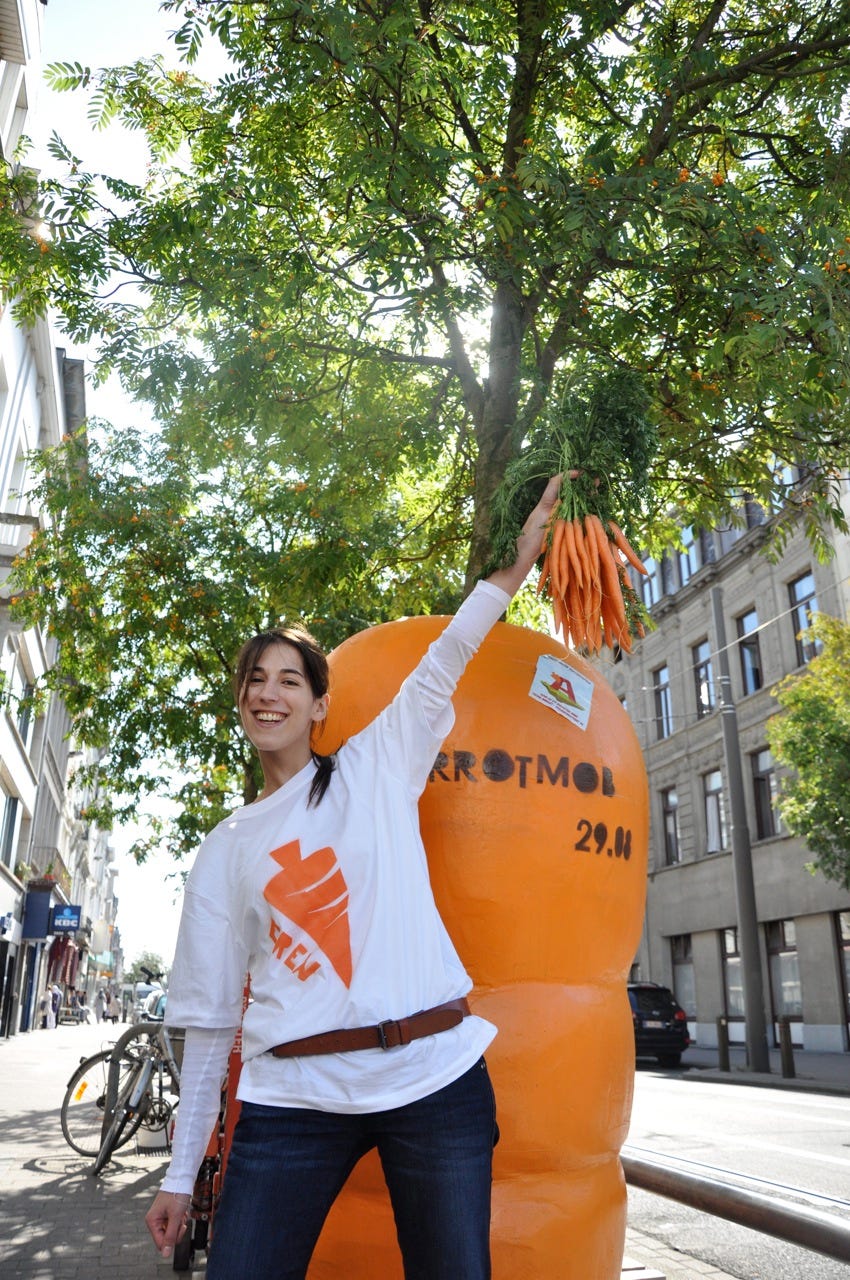
We tried to scale Carrotmob by building tools for community organizers.
That failed.
We built a way to integrate Carrotmob into e-commerce sites, and did a ridiculous campaign to help a coffee company ship 100% of their coffee around the world using sailboats instead of oil.
That failed.
We wanted to work with massive companies, so we did a pilot program with Unilever. It succeeded, but we learned that without a massive amount of capital or millions of people, doing large-scale campaigns with global brands was not viable.
We built a product for Carrotmobbing with online vouchers, and Google hired us to organize a campaign like this with them in Mountain View. That was great, but failed to help us scale.
We tried one more pivot, which also failed.
Overall, we wanted Carrotmob campaigns to be widely available for everyone to participate in with high frequency, and we thought that if we could scale that, we could change the way capitalism worked, and have a massive impact on important issues like climate change.
We failed to make that vision a reality.
Needs that Carrotmob could not meet:
- Convenience/ease: We gave people a way to make a difference that was easier than many other traditional forms of activism, but it still wasn’t easy enough to fit into ordinary peoples’ lives. After the first Carrotmob event, someone told me, “That was AMAZING. But just so you know, I’m probably never again going to wait in line for an hour to go to a liquor store.”
- Frequency: We buy things constantly, and we want to “vote with our money” every time, but Carrotmob couldn’t provide that. It takes someone about 6 weeks to organize a traditional Carrotmob campaign. At best, you might get 2 or 3 chances per year to participate.
- Choice of businesses: Everyday Carrotmobbers couldn’t choose which business to mob. They relied entirely on the decision of organizers.
- Individual expression: We each have our own values and passions, and we may have different things that we would want a business to do. But the only message you can send to a business with Carrotmob is something that a committed organizer and the business have already agreed upon in advance. There is no place for individual preference.
- Knowing if customers care: Before they invest time/money participating in a campaign, businesses want to know whether customers actually care about an issue and will support them. But there was no way to know that until people actually showed up (or didn’t) to make their purchases.
Key insights:
People (including me and many of you reading this) went NUTS for Carrotmob. What itches did it scratch that made us so excited?
- People wanted to be able to do something positive and productive.
- People wanted to express their values, and have an impact.
- People wanted a way to resolve a conflict that nagged at their own identity: They saw evidence of great harm being done by businesses, and yet they were willing participants in a capitalist system that facilitated this harm. Having clear evidence that a certain purchase had a clear positive impact on the world offered resolution to that emotional dissonance.
- People academically understand that “money is power” but that feels hollow, especially when facing down a multinational corporation all by yourself. Collective action and impact lets you actually feel that power.
- People want to feel heard. Like businesses care. Like their purchase decisions matter.
But if I could sum up a decade of lessons into one sentence I would say this:
People really, really want to vote with their money.
Why MoneyVoice
The question then became: “If people want to ‘vote with their money,’ how can we best fulfill that desire?” I set aside the ideas of “events” and “campaigns” and advanced coordination between businesses and customers. What if we took the idea of “voting” quite literally? What if there were an app that let you actually vote with your money, every time you made a purchase?
That’s what MoneyVoice is. You install the app, link a payment card, and every time you make a purchase you earn one “vote” at that business. You can vote for what you want the business to do. Pretty simple.
You can learn more, install the iPhone app, or read my post about the meaning of voting with your money, and what MoneyVoice means for this potent cultural phenomenon that has going on for centuries.
Why MoneyVoice succeeds where Carrotmob failed
MoneyVoice scratches the same itches that made us love Carrotmob: It’s a way for us to do something positive and productive, expressing our values, having an impact, and feeling our power. It makes us feel heard, and in those painful moments when we are making a purchase that doesn’t fully-align with our values/identity, it gives us a way to redefine the meaning of that purchase and return to a place of emotional alignment. It lets us vote with our money.
But you will notice that MoneyVoice is also able to meet all of the needs that Carrotmob couldn’t:
- Convenience/ease: Giving feedback to a business by voting for something you agree with takes one tap. You can send a powerful message to ten different businesses in less than a minute, whenever you want.
- Frequency: You can “vote” with every purchase, not just twice a year.
- Choice of businesses: You decide what businesses you want to try and impact. Neither an organizer or the business themselves is a gatekeeper controlling what businesses you can vote on.
- Individual expression: You can write your own unique feedback and recruit others to vote for your idea, or just support what you agree with.
- Knowing if customers care: Businesses know upfront what their customers care about. In that moment when they are deciding whether to take an action, this gives them much more confidence, especially because they know the feedback is coming from verified customers who have supported them in the past and are likely to do so again in the future.
What’s next
Within the past week, just in time for Carrotmob’s 10th birthday, we had the first example of MoneyVoice feedback successfully changing a business. One of our users asked a Mexican restaurant to put a vegan entree on the menu, other users voted for that, and the restaurant has now introduced a vegan entree at all three locations (join us to celebrate!). This is only the first taste of the impact we can have (which I discuss in more depth in this video).
I believe that MoneyVoice is much better-equipped than Carrotmob ever was to scale the impact we can have as customers and actually change capitalism in a systemic way. When we use MoneyVoice, there is no limit to the changes that we can try to make in businesses, and no limit to the speed at which we can make them. Businesses make decisions based on financial data that we have never had a good way to influence. But MoneyVoice lets us translate our values into financial data… this is how our voices will now be heard like never before.
Within MoneyVoice, Carrotmob is reborn. The best birthday gift you could give is to join us and start harnessing the latent power inherent in every purchase you make. Enjoy!

Brent Schulkin founded Carrotmob and MoneyVoice. Follow him on Twitter.