
Our existing strategies for addressing the climate crisis are not enough. Governments could lead, but the Trump administration is the worst-case scenario that has come true. The economic advantages of renewable energy are fantastic, but it’s not enough. Relying on individuals making good choices is not enough. Nothing that is happening is anywhere near close to enough.
It may seem that the deck is stacked against us, but I’m pleased to report that we still have an ace up our sleeve. We have always held this card, with all of its special powers, but we never had a way to play it until now. Allow me to reveal this card for the first time and shed some light on how this next gambit can sidestep our biggest obstacles and allow us to dramatically accelerate climate progress.
Here in the US, our climate strategy has focused on pushing for government action. This is still a great strategy at the state and local levels, but at the federal level it is, for the moment, doomed. We are facing a climate emergency and cannot wait for the next administration. We need a new strategy to drive radical change as fast as possible, without relying on the federal government.
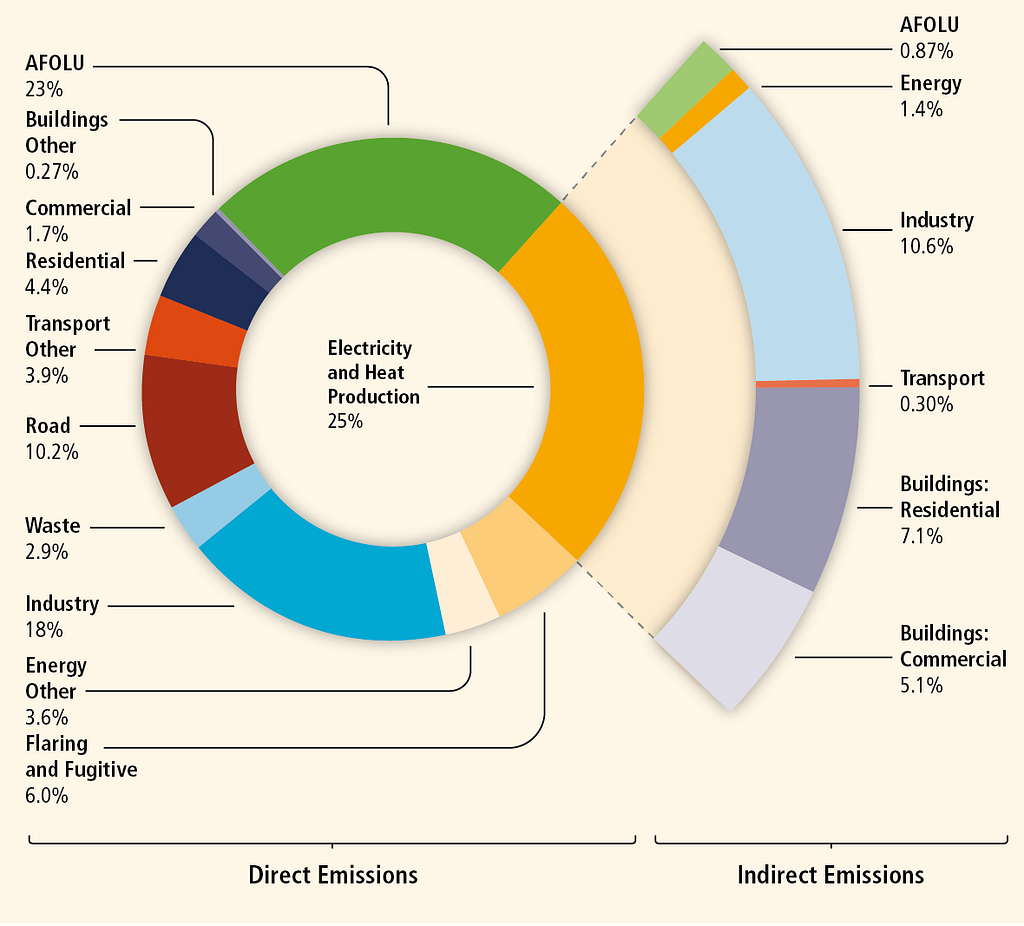
First, let’s revisit what has to happen. We have to reduce greenhouse gas emissions. Here is what causes them:
If we simplify this data, there are basically four categories to address:
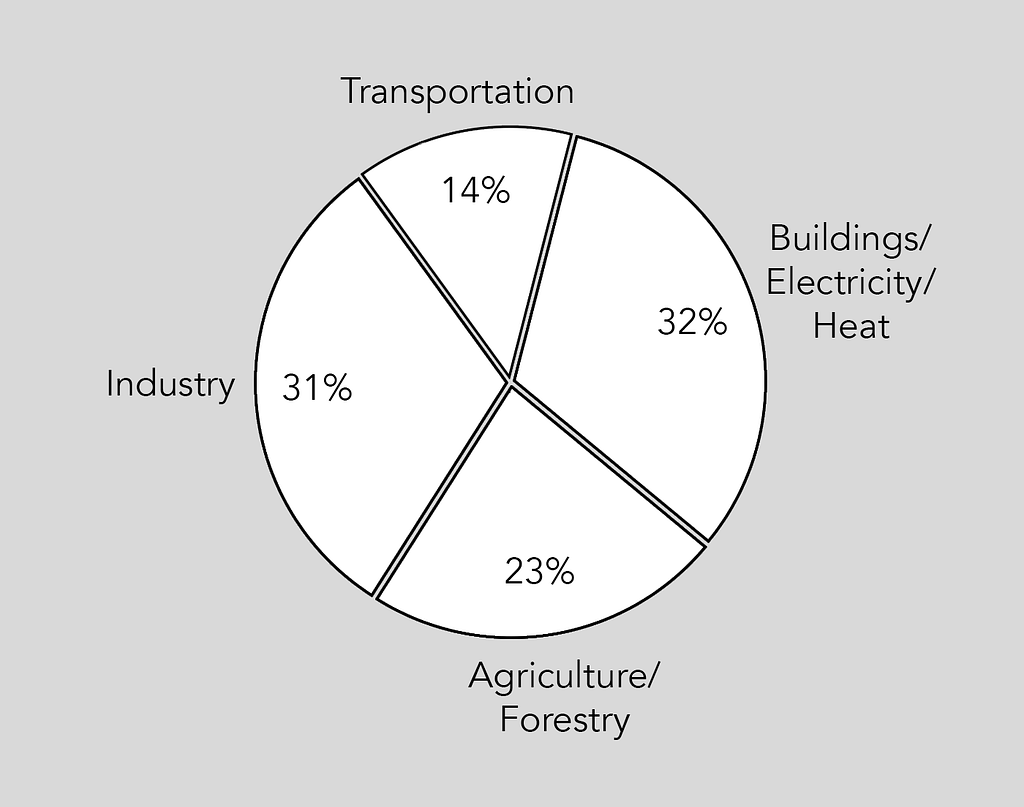
Changing these systems requires making changes to millions of tiny aspects of how the world works….

A farmer named Javier in Fresno needs to change the way he grows his almonds.
The lights in the Marriott hotel in Columbus, Ohio need to have motion sensors installed.
An auto body shop in Jacksonville needs solar panels on the roof.
How do we make millions of changes like this happen? There’s an easy way and a hard way.
The easy way is passing a carbon tax to make it more expensive for businesses to emit greenhouse gases. The federal government putting a price on carbon emissions sets off a beautiful chain reaction of economic forces that ultimately leads to all these changes getting made. It’s simple, effective, necessary… and not happening.
So now we have to make millions of changes the hard way. The hard way means that instead of just making one simple policy change, we must get our hands dirty and directly make all of these changes happen ourselves. Which means we actually need to find a direct way to install motion sensors in the Marriott hotel in Columbus, Ohio. This seems quite hard because we don’t control that hotel’s lighting system. Neither does the government. We cannot “vote” to install those motion sensors. This obstacle prevents us from making millions of changes that we must make. If we want a successful strategy to transform our global systems, we must be crystal clear on who is in direct control of those systems.
Even though the government has indirect influence over all of these systems, they have very little direct control. The government does manage a tiny amount of buildings, land, industry and transportation, but businesses and people like us control the overwhelming majority. For example, almost half of transportation emissions come from trucking, freight shipping, and commercial vehicle fleets. Businesses also control the manufacturing of cars, trucks, buses, ships, planes and trains. People just control how we buy and use these vehicles to move ourselves around:
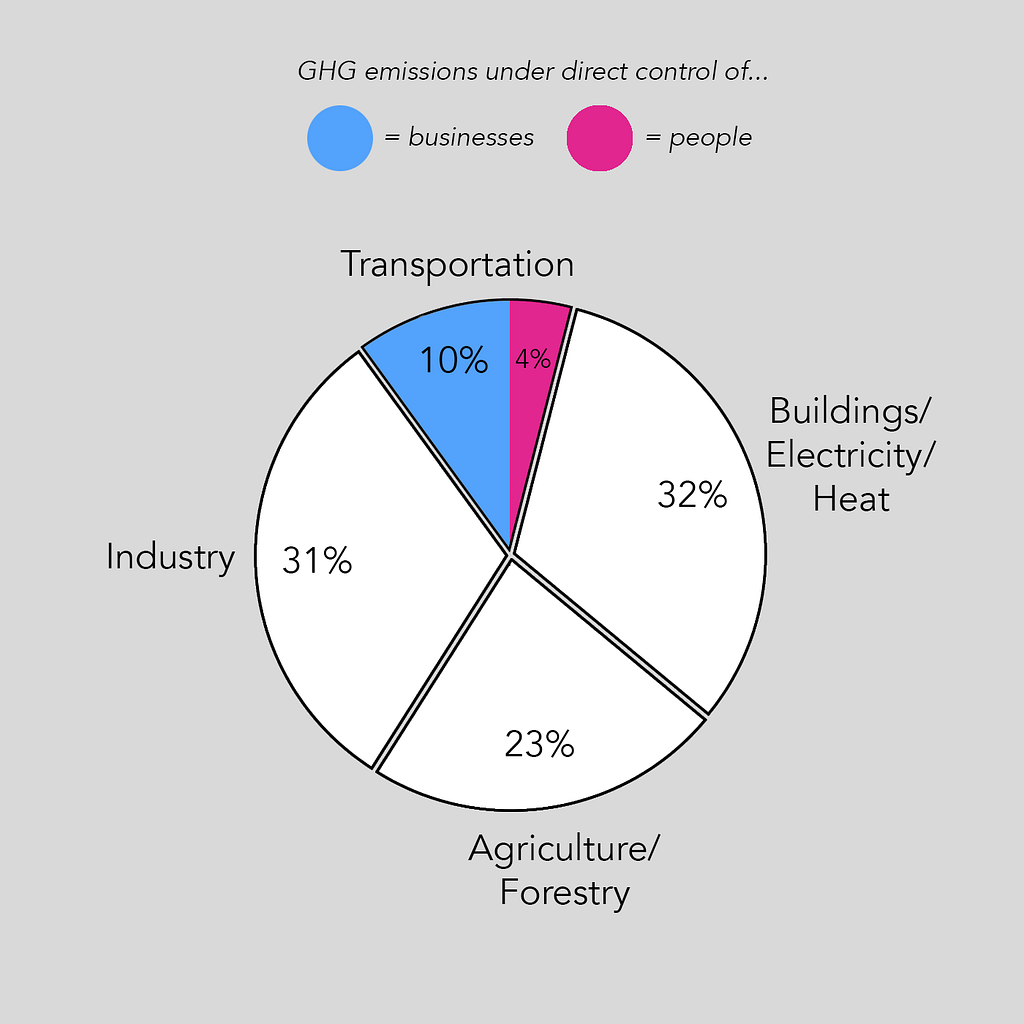
About 12% of emissions are from residential buildings where we control electricity and heating. 20% is from buildings controlled by businesses:
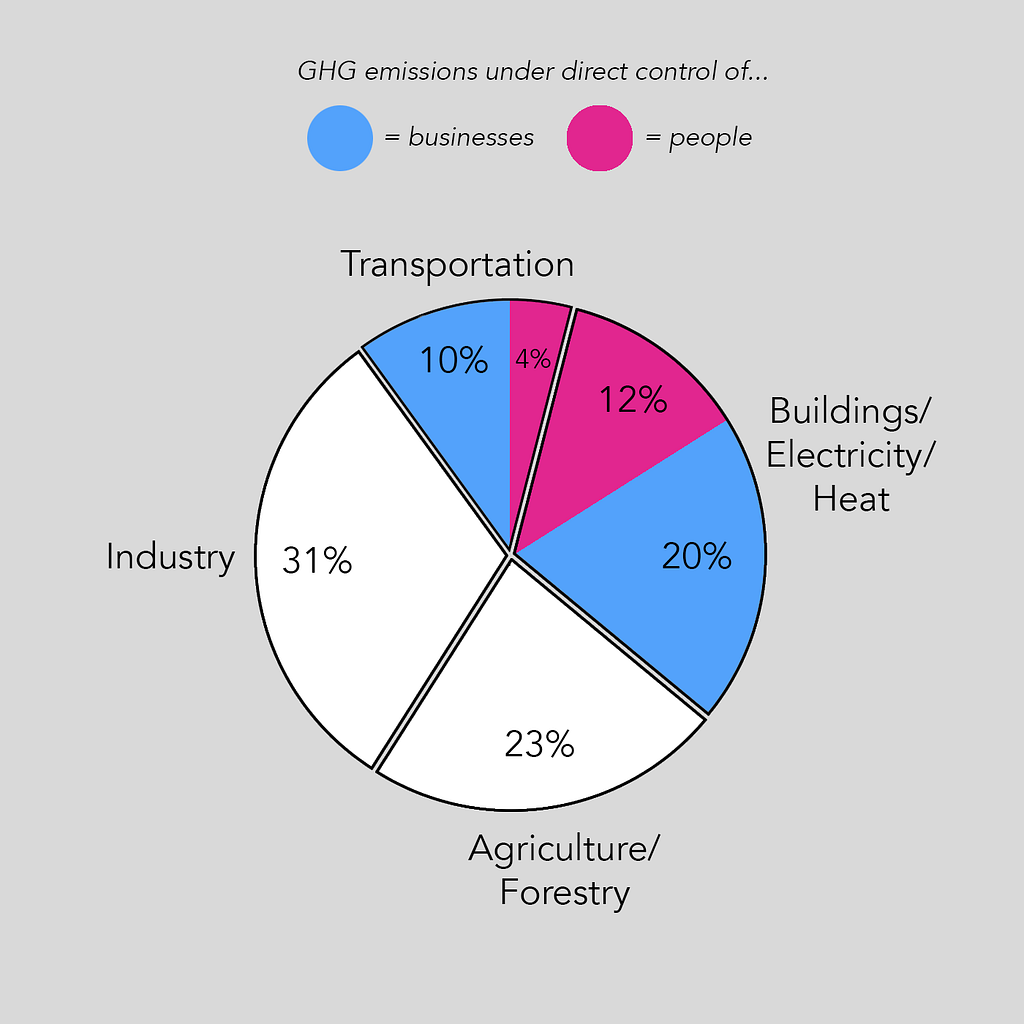
Who produces all the food in the world? Who grows the timber to build our houses, and the cotton to make our clothes? Despite your vegetable garden and your diet, we pretty much have to say that businesses control the entire agricultural system. Businesses basically control the “industry” category as well. So when we look at everything that must change, you will see that we directly control about 16% of it, but 84% of it is controlled by businesses:
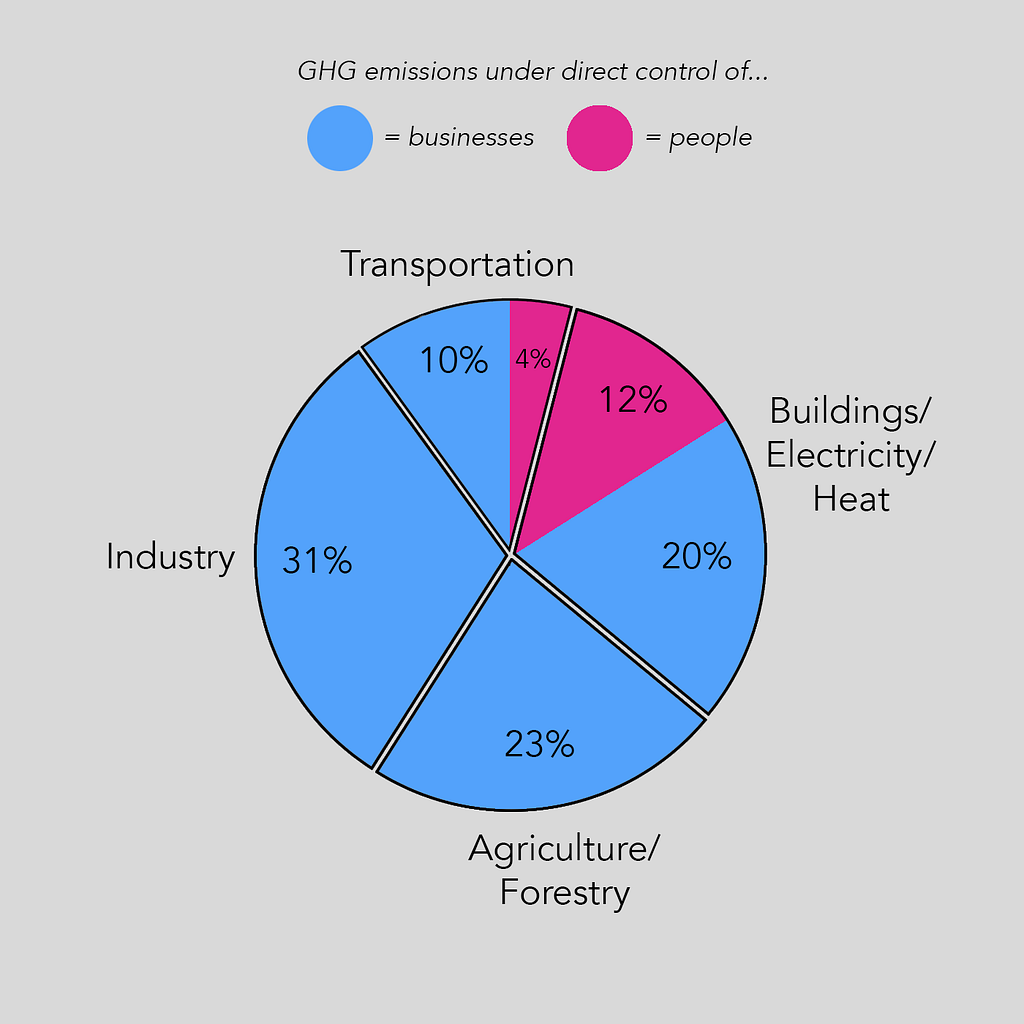
Striking, isn’t it? For decades, we have been hard at work on the parts we control. We have been carpooling and changing our lightbulbs. But the radical change we need now is in the 84%. Businesses are not evolving fast enough. In the absence of government intervention, we must now gain control over businesses so we can make them change. That may sound impossible, but “impossible” is a dare. Let us accept her invitation.
The first step in taking control of what businesses do is understanding how they work. I’m speaking in broad generalities, but overall, businesses do whatever makes them the most money. How do they decide what will make them the most money? They ask their financial analyst. And how does their financial analyst decide what makes money? By looking at data. And out of all the data they look at, what is the most important and influential data for any business? What customers want. Data about consumer demand is ultimately what drives decision-making at businesses.
Regardless of what the government does, if consumer demand data indicated to financial analysts that businesses would make more money by taking radical climate action, then this 84% would transform extremely quickly. If the Marriott in Columbus had data indicating that their customers who spent the most money wanted motion sensors, and investing in motion sensors would increase loyalty and sales, they would do it. The power of this sort of data is often ignored, and yet it can trigger precisely the actions that must happen. This data could be the most powerful force currently at our disposal for preserving a habitable biosphere.
Now let’s get into the heads of the financial analysts who drive decision-making at every big business. Any business must understand what their customers want. If they don’t, they die. To better understand customers, these analysts seek massive amounts of data, and use very sophisticated techniques. There’s just one problem: They still don’t know what we want.
Only we actually know what we want. If I’m a Home Depot customer who cares about climate change, I probably want them to put solar panels on the roof of their store. If they did, I’d be a more loyal customer because I’d know they shared my values. But the financial analyst doesn’t know I want solar panels on the roof, so Home Depot is less likely to install them. All their analyst knows is that I am a male in California who bought duct tape and spring clamps. Based on that, there’s no way they can guess how strongly I feel about clean energy. It would be a lot better for everyone if I just had an easy way to tell them, “please install solar panels.” Now you might say that people already do this with Yelp, Twitter, or petitions. But the problem is that financial analysts don’t read what you say on Yelp, Twitter or petitions (because it’s completely unrelated to financial analysis). As a result, businesses don’t know how much we care about climate change. They are slow to take climate action because the financial opportunity is invisible to them.
So, if each of us could somehow give these financial analysts data proving that climate action were important to us, it would cause a massive acceleration in the deployment of climate solutions by businesses. No longer would we be helpless to influence the 84%. Our power as customers could actually drive millions of rapid changes in the world’s agriculture, buildings, transportation, and industry.
The only thing that has been missing is the right tool. We need a tool that makes it easy for any customer to quickly tell businesses they want climate action. But in order for this message to actually influence businesses, the tool must provide this information in the form of rich financial data which is actually useful for the analysts. The ace up our sleeve is the fact that we control consumer demand, so we have power over the entire economy. But we cannot use that power unless we have a tool to get organized and actually express that power in a way that can be understood by businesses.
For the past three years our team has been building this tool. We hope it can give people unprecedented influence over how businesses make decisions. If you use it, maybe we can play our ace and turn capitalism into a massive engine for climate progress. It’s called MoneyVoice:

Brent Schulkin is the Founder/CEO of MoneyVoice. Follow him on Twitter.